A small AI chatbot for a business website typically costs between $20 and $200 per month to run in the cloud, with most small setups landing around $50 to $100 a month once hosting, model calls, and a small database are added up. The exact number depends on how many people talk to it and how clever you need its answers to be — but for a typical small business answering a few hundred questions a day, the bill is closer to a phone plan than to a salary.
That surprises most owners. The headlines are full of companies spending millions on AI, but those are training giant models from scratch. Running a chatbot is a different job: you rent someone else’s model by the message, host a small website around it, and pay only for what you use. This guide breaks down every line of that bill, with a worked example, so you can budget honestly before you build.
What does “running a chatbot” actually mean?
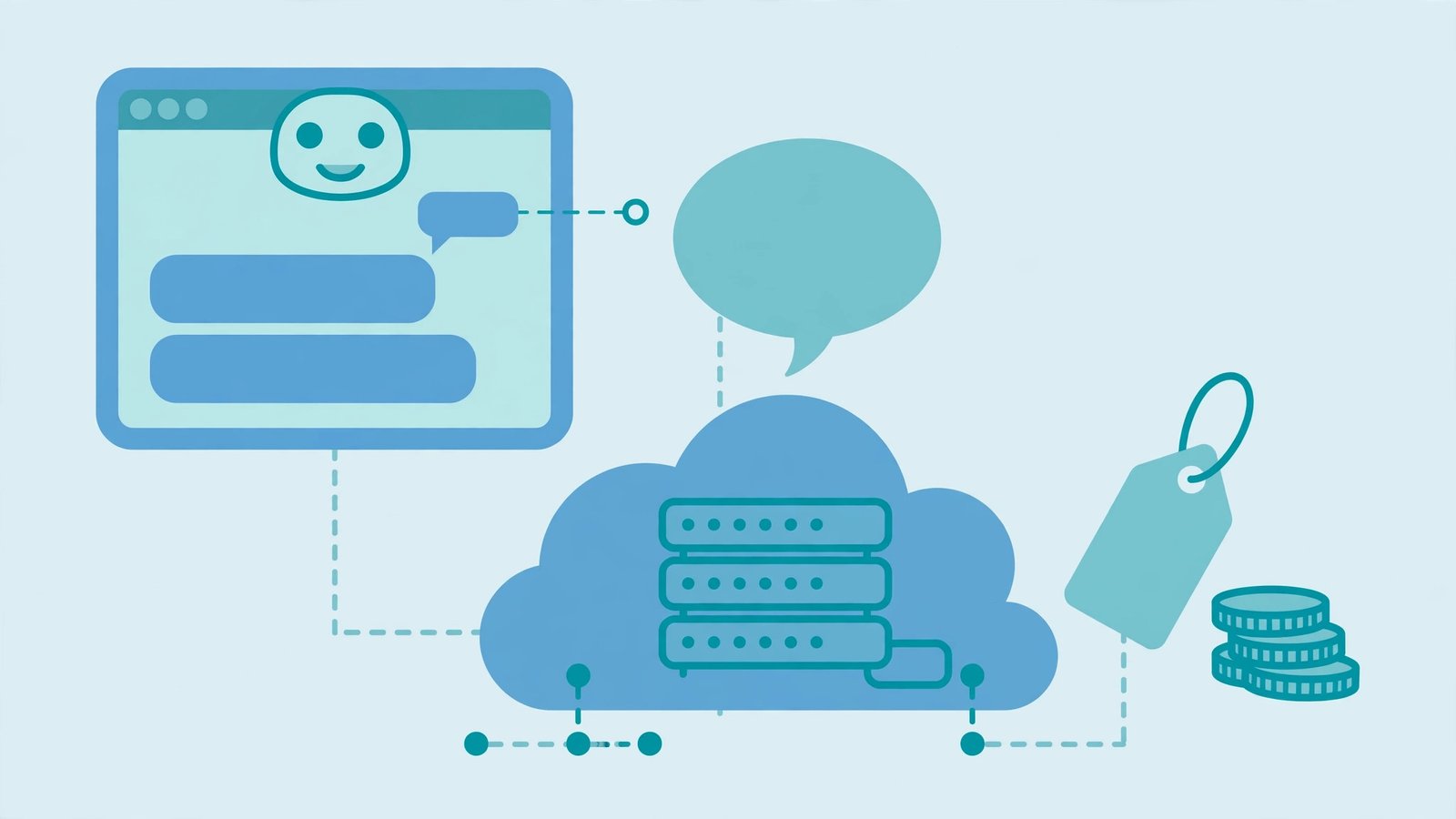
A chatbot is not one thing you buy — it is four small parts working together:
- The model — the AI brain, rented from a provider such as OpenAI, Google, or AWS Bedrock. You pay per message, not per month.
- The hosting — a small server or serverless function that receives the visitor’s question, sends it to the model, and returns the answer.
- The knowledge base — your own documents (FAQs, product pages, policies) stored in a small database so the bot answers about your business, not the whole internet.
- The website widget — the little chat bubble on your site. Usually free or a few dollars a month.
Each part bills differently: the model is pay-per-use, hosting is mostly fixed, and the database is nearly free at small scale. That is why two chatbots with the same code can cost $15 or $300 a month — the difference is almost always traffic and model choice, not the software.
How much does the AI model cost per message?
Model providers charge by the “token” — roughly three-quarters of a word. A typical customer question plus the bot’s answer runs about 500 to 1,000 tokens in total. Here is what that means in plain money:
| Model tier | Rough cost per 1,000 conversations | Best for |
|---|---|---|
| Budget models (e.g. GPT-4o mini class, Gemini Flash) | $3–$10 | FAQs, order tracking, simple support |
| Mid-range models (e.g. GPT-4o class, Claude Sonnet class) | $30–$80 | Nuanced answers, longer conversations |
| Top-tier models (e.g. GPT-5 class, Claude Opus class) | $150–$400 | Complex reasoning, rare edge cases |
The practical lesson: start with a budget model. For answering “what are your opening hours?” or “do you ship to my city?”, a budget model is indistinguishable from an expensive one — and roughly ten times cheaper. You can route only the tricky questions to a stronger model later, a trick engineers call “model routing” that can cut a bill in half without anyone noticing.
One more cost driver people miss: the knowledge base. Every time the bot answers, it also reads a chunk of your documents to stay accurate. Keeping those documents short and well-organised — a tight FAQ page rather than a 200-page manual dumped in whole — directly lowers your token bill.
What does hosting cost?
For a small chatbot, hosting is the cheapest line item, and there are three honest options:
- Serverless (AWS Lambda, Cloudflare Workers, Vercel): pay per request; a small chatbot often stays inside the free tier. Realistic cost: $0–$10 a month.
- A small VPS (DigitalOcean, Lightsail, Hetzner): a fixed $5–$12 a month for a server that can also host your website. Simple and predictable.
- A managed chatbot platform (Intercom, Tidio, Zendesk AI): $30–$100+ a month, but setup is point-and-click and hosting is included. You pay for convenience, not compute.
If you are building your own bot with a developer, serverless or a small VPS is the sensible default. If you want it live this week with no developer, a managed platform’s higher fee buys you that speed — just check whether its AI add-on is billed separately, because that is where surprise charges hide.
The worked example: a 10-person business, 300 chats a day
Let us put real numbers on a realistic case: a small online shop adds a chatbot to answer delivery questions, return questions, and product questions. It handles 300 conversations a day, about 9,000 a month, using a budget model with a tidy FAQ knowledge base.
| Line item | Monthly cost |
|---|---|
| Model calls (9,000 chats, budget model, ~700 tokens each) | $15–$30 |
| Serverless hosting + API gateway | $0–$5 |
| Vector database for the knowledge base (small tier) | $0–$10 |
| Domain, chat widget, monitoring | $0–$5 |
| Total | $15–$50 |
Now change one variable: swap the budget model for a mid-range one and the model line jumps to roughly $90–$150, pushing the total to $100–$200 a month. Grow to 2,000 chats a day and even the budget model costs $100–$200. The formula is simple — chats per month × tokens per chat × model price. Before you sign anything, estimate your chats per month from your current contact-form and email volume; that single number predicts your bill better than any vendor quote.
What are the hidden costs nobody puts in the quote?
The cloud bill is only part of the story. Budget for these too:
- Setup and tuning (one-off): writing good FAQs, testing answers, and fixing the bot’s confident mistakes takes a few days of someone’s time, whether that is you or a freelancer. Expect $300–$1,500 once, not monthly.
- Review time (ongoing): spend 30 minutes a week reading a sample of conversations. This is how you catch the bot giving wrong prices or outdated policies — and it is the cheapest quality control there is.
- The “it worked too well” saving: if the bot deflects half your support emails, you save staff time worth far more than the bill. A chatbot that costs $80 a month and saves ten staff hours a month is not an expense; it is a bargain. Measure deflection from day one so you can prove it.
- Overage surprises: the classic trap is an uncapped API key with no spending limit. Always set a monthly cap and billing alerts at 50% and 80% — a five-minute job that prevents the horror-story bills.
How do you keep the bill small?
- Start on a budget model. Upgrade only if real conversations show the answers are too weak.
- Keep answers short. A 60-word answer costs a third of a 200-word one. Tell the bot to be concise.
- Cache common answers. The top 20 questions are usually half your traffic; answering those from a stored FAQ instead of the model cuts token use dramatically.
- Set a spending cap and alerts on day one. Non-negotiable.
- Use your cloud provider’s free tiers. AWS Bedrock, Google Vertex AI, and Azure OpenAI all offer starter credits — and keeping the bot on the cloud you already host on avoids extra data-transfer fees.
So, what should you budget?
For a small business chatbot answering a few hundred questions a day, budget $50 a month and you will usually come in under it. If you expect thousands of chats a day or need a top-tier model for complex advice, budget $200–$400. Either way, the cloud makes this a utility bill, not a capital project — start small, watch the meter for a month, and scale with the traffic you actually get.
Frequently asked questions
How much does it cost to run an AI chatbot in the cloud for a small business?
Most small business chatbots cost $20–$200 per month in the cloud, with a typical setup around $50–$100. The biggest cost is the AI model, billed per conversation; hosting and the knowledge base usually add less than $20 combined.
Is it cheaper to use OpenAI, Google, or AWS for a chatbot?
At small scale the difference is small — all three offer budget models in a similar price band. Pick the one your developer already knows or the cloud you already host on; switching later is easy, and the real savings come from choosing a budget model and keeping answers concise.
Do I need a developer to run a chatbot in the cloud?
Not necessarily. Managed platforms let you launch without code for $30–$100+ a month. A custom cloud chatbot needs a developer for setup but usually costs less per month afterwards. For most small businesses, starting managed and moving custom later is the sensible path.
What is the cheapest way to run an AI chatbot?
A budget model plus serverless hosting plus a small free-tier database — often $15–$50 a month for a few hundred chats a day. Add a monthly spending cap, cache your most common answers, and keep responses short to stay at the low end.