AWS Bedrock vs Google Vertex AI vs Azure OpenAI: A Beginner’s Comparison
You want to add AI to your app or business, and every guide points you at one of three names: AWS Bedrock, Google Vertex AI, or Azure OpenAI. They all sound similar, they all come from a giant cloud company, and their pricing pages all read like legal documents. Which one should a beginner actually pick?
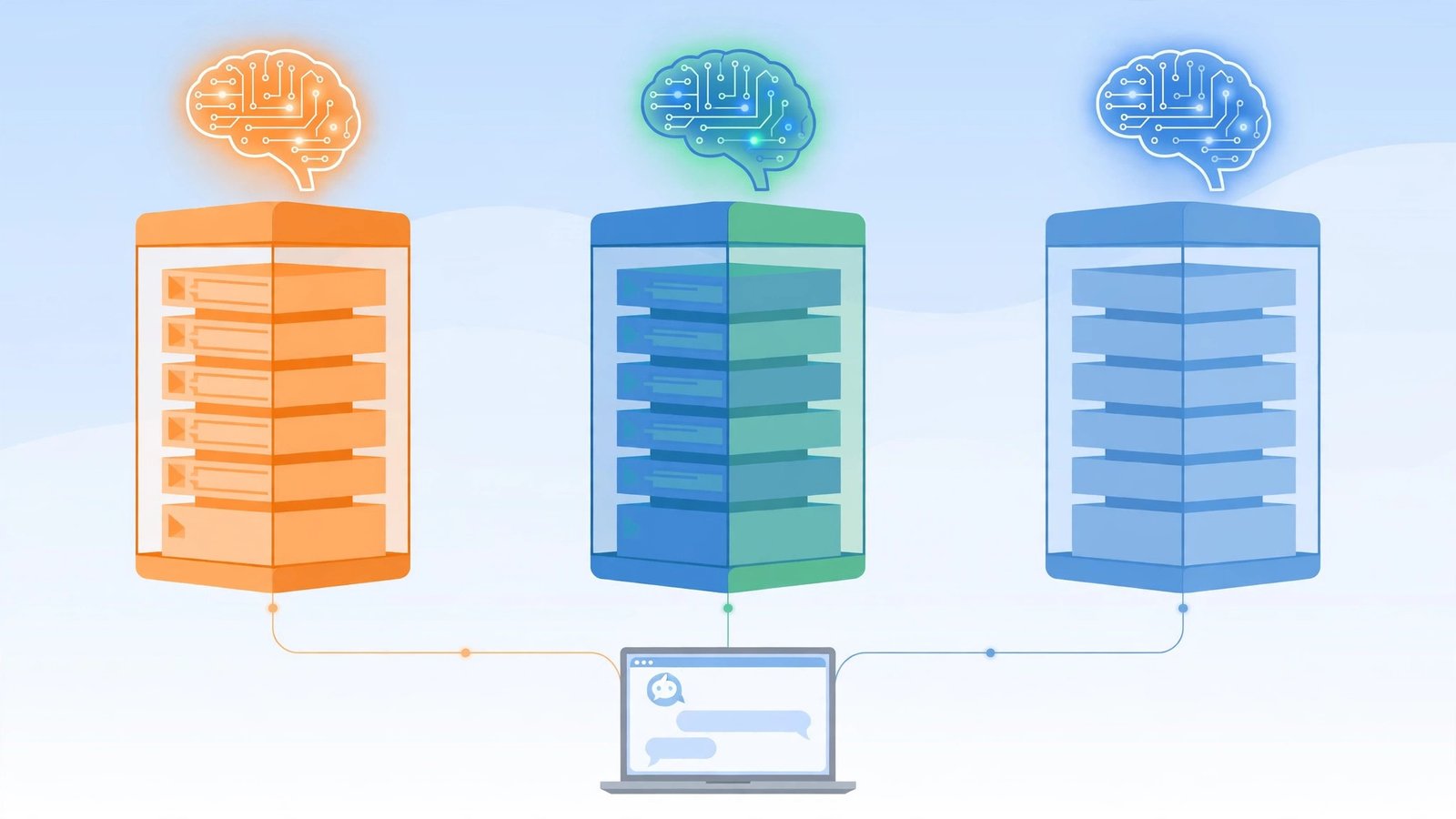
AWS Bedrock vs Vertex AI vs Azure OpenAI for beginners comes down to this: Bedrock offers the widest choice of models from different companies, Vertex AI pairs Google’s models with the strongest tools for training your own, and Azure OpenAI gives you OpenAI’s models — the ones behind ChatGPT — inside Microsoft’s cloud. New to all three? Start with Azure OpenAI.
What Are Bedrock, Vertex AI and Azure OpenAI, in Plain English?
All three are “managed AI platforms”: somebody else owns the expensive graphics cards and keeps the AI models running, and you send text through an internet connection and get answers back. You pay for what you use, and you never buy a server.
AWS Bedrock is Amazon’s platform, and its big idea is choice: instead of locking you into one company’s models, it lets you pick from Amazon’s Titan, Anthropic’s Claude, Meta’s Llama, Mistral and Cohere through the same door, and swap models without rewriting your app.
Google Vertex AI is Google’s platform, and its big idea is depth: it comes with Google’s Gemini models, plus a full workshop for building your own AI — tools to train models and tune them on your data.
Azure OpenAI is Microsoft’s way of selling OpenAI’s models — GPT-4o, GPT-4o mini and the embedding models — through its Azure cloud. Its big idea is familiarity: if you have used ChatGPT, you already know what these models can do.
AWS Bedrock vs Vertex AI vs Azure OpenAI for Beginners: The Quick Comparison
- Choice of models: Bedrock wins. It offers models from many companies under one roof, so you can test Claude against Llama against Titan in an afternoon. Vertex AI offers Google’s Gemini plus open models. Azure OpenAI offers OpenAI’s models only — fewer choices, but the most famous ones.
- Ease of use for a first project: Azure OpenAI wins. If you have used ChatGPT, the concepts transfer immediately, and Microsoft’s documentation is written for app developers rather than machine-learning engineers.
- Customizing with your own data: Vertex AI wins. Its tuning tools are the most mature, and it is the natural home if you want to train a model on your own documents.
- Working with the rest of your cloud: All three win — inside their own cloud. Bedrock pairs naturally with AWS services like S3 and Lambda, Vertex AI with Google Cloud storage and BigQuery, Azure OpenAI with Microsoft 365 and Azure databases. The platform that matches the cloud you already use saves you the most setup time.
- Privacy: All three promise your data is not used to train their models, and all three offer enterprise-grade controls.
Which Models Can You Actually Use on Each Platform?
On Bedrock, the headline models are Anthropic’s Claude (widely considered the best for writing and careful reasoning), Amazon Titan, Meta’s Llama, and Mistral (fast and efficient). If your project needs a model that is good at long documents, Claude is usually the first one people try.
On Vertex AI, the headline is Google’s Gemini family: Gemini 2.5 Flash is fast and cheap for everyday tasks, and Gemini 2.5 Pro handles the hard reasoning. Vertex AI is also the only one of the three with a serious image and video generation story built in (Imagen and Veo).
On Azure OpenAI, the headline is GPT-4o and its smaller sibling GPT-4o mini — the models behind ChatGPT. If your users already like ChatGPT’s answers, giving them the same model inside your app is the shortest path to a result they trust.
How Much Does Each One Cost to Try?
All three charge per use — roughly per thousand words you send in and per thousand words you get back. At beginner volumes the differences are small.
- Azure OpenAI: GPT-4o mini costs a fraction of a cent per thousand words, so a small chatbot answering a few hundred questions a day typically runs to a few dollars a month. Microsoft’s Azure free account includes credits for new users.
- AWS Bedrock: Prices vary by model, but the cheapest options (Titan, Llama) are comparably cheap, and on-demand pricing means you pay nothing when nobody uses your app. AWS also offers a free tier for new accounts.
- Google Vertex AI: Gemini 2.5 Flash is one of the cheapest capable models on the market, and Google Cloud’s free tier includes a generous monthly allowance — enough for many hobby projects to cost nothing at all.
The mini-test I recommend: build the same tiny project — a web page that summarizes a paragraph — on your chosen platform’s free tier, and send it 100 requests. Whatever the bill says, multiply it by ten: that is your realistic monthly cost at ten times the volume, and for most beginner projects the answer is under $10. The expensive mistake is picking the biggest flagship model when the smallest one would do — start cheap, and upgrade only when the answers are not good enough.
Which One Is Easiest for a First Project?
If you already use one of the three clouds, the answer is that one — no contest. Your login, billing and storage already exist, and you skip a day of account setup.
If you use none of them, here is the honest ranking for a complete beginner. Azure OpenAI is the shortest path from zero to a working AI feature: the examples are plentiful, the models are familiar, and the Azure portal’s “playground” lets you test prompts in your browser before writing any code. AWS Bedrock is almost as easy, and its playground lets you compare answers from different models side by side. Google Vertex AI is the most powerful, but the console assumes more background knowledge — a steeper first afternoon.
Which Should You Pick? A Simple Decision Guide
- You want ChatGPT-style AI in your app, fast: Azure OpenAI.
- You want to compare several different models before committing: AWS Bedrock.
- You want to train or fine-tune a model on your own data: Google Vertex AI.
- You already run your website or app on AWS, Google Cloud, or Azure: the AI platform from that same company, every time.
- You just want the cheapest possible experiment: try Gemini 2.5 Flash on Vertex AI’s free tier, or GPT-4o mini on Azure — both are nearly free at hobby scale.
One piece of advice that matters more than the choice itself in any AWS Bedrock vs Vertex AI vs Azure OpenAI for beginners comparison: do not spend a week comparing. Spend an afternoon building. The three platforms are similar enough at beginner level that a working project on the “wrong” one teaches you ten times more than a perfect comparison spreadsheet.
Frequently Asked Questions
Can I try AWS Bedrock, Vertex AI or Azure OpenAI for free?
Yes — new-account credits on AWS and Azure, and a free tier with a monthly Gemini allowance on Google Cloud. At hobby scale, many small projects cost nothing or a few dollars a month. The full-size flagship models cost far more per request than the small ones, so start small.
Is Azure OpenAI the same thing as ChatGPT?
Not quite. ChatGPT is the consumer app; Azure OpenAI is the developer service that runs the same OpenAI models (like GPT-4o) inside Microsoft’s cloud, with business privacy controls and your own usage limits. Same brains, different wrapper.
Which platform is best for a small business chatbot?
For most small businesses, Azure OpenAI with GPT-4o mini is the simplest choice: familiar model quality, low cost, and easy integration. If your business already runs on AWS or Google Cloud, use that cloud’s AI platform instead.
Do I need to know machine learning to use these platforms?
No. You send text through an API and get answers back — no training, no GPUs, no math. The platforms handle the models; you handle the app around them. Basic programming, or even a no-code tool that connects to the API, is enough to build your first AI feature.
AWS Bedrock, Vertex AI and Azure OpenAI are three doors into the same room: powerful AI models you can rent by the word. Bedrock offers the widest choice, Vertex AI offers the deepest workshop, and Azure OpenAI offers the most familiar models. Pick the one that matches the cloud you already use — or Azure OpenAI if you use none — build something small this week, and let the real project teach you the rest.